69 dead after high-speed train collision in central Spain
Rescue teams continue searching for survivors in the wreckage as Spain declares three days of mourning ahead of its November 29 election.
By Sofia Wisniewski ·
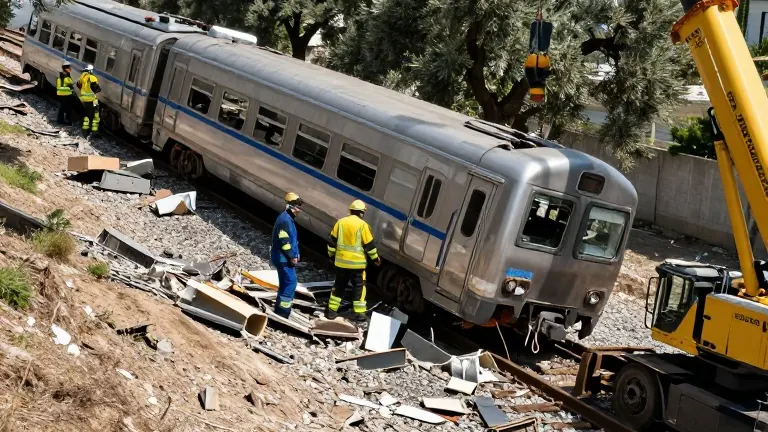
The death toll from a high-speed rail collision in central Spain has risen to 69, with officials warning the number may climb as search operations continue. The accident, which occurred on Wednesday morning, marks the second deadly crash on the country's high-speed network this year. Rescue crews, supported by sniffer dogs and cranes, spent Thursday morning sifting through debris scattered across a gravel slope where at least three train carriages were displaced by the impact.
Emiliano García-Page, the regional leader of Castilla La Mancha, confirmed the provisional death count after one additional body was recovered overnight. He noted that 50 people remain hospitalized and that identification efforts are complicated by the recovery of body parts. García-Page described the event as a catastrophe that has left the entire nation in shock.
The Spanish government declared three days of national mourning beginning Thursday. In Canada, Global Affairs Canada reported that six citizens were injured in the crash and a seventh remains unaccounted for. The department cited privacy concerns when declining to specify the severity of the injuries but stated that consular officials are in contact with local authorities to gather more details.
Transport Minister Óscar Puente addressed questions regarding his potential resignation following the second major wreck under his tenure. He stated that his focus remains on managing the collision rather than his political future. Puente attributed the crash to an "inexplicable" order issued by a central command center after a security system malfunction.
According to the minister, a computer malfunction caused the security system on a 63-kilometer stretch of track to fail at 8:30 a.m. local time, forcing all trains on that line to stop. An IRYO train remained halted near the town of Urda, while a RENFE train stopped 25 kilometers behind it. Minutes later, the central command instructed the RENFE train to resume movement without speed restrictions. The train subsequently collided with the stationary IRYO train at 8:53 a.m.
Puente explained that the RENFE train should not have been authorized to move because a stop signal remained active. He added that if movement had been permitted, the train should have been instructed to travel at a reduced speed. He emphasized that the train engineers were not at fault for the collision.
The incident has disrupted the high-speed line connecting Madrid and Seville, leaving thousands of travelers stranded. Both fatal crashes this year occurred on the same rail line and involved a state-owned RENFE train and a privately operated IRYO train. Spain liberalized its high-speed rail market in 2021, with IRYO beginning service the following year. The network, the second-largest in the world after China's, had not experienced a deadly crash since its inception more than three decades ago, until the January incident that killed 46 people.
Prime Minister Pedro Sánchez visited the crash site in the province of Toledo on Wednesday. He pledged a thorough investigation and improvements to safety protocols to rebuild public trust in the rail system. Sánchez stated that enduring two high-speed train accidents in the same year is unacceptable for a country of Spain's stature. The collision comes four weeks before the national election scheduled for November 29, adding a new issue to the campaign trail.
Sánchez, who has led the country since 2018, faces a challenging election environment driven by discontent over housing costs and high rents. He also contends with criticism from right-wing parties regarding migration policies and corruption accusations against his party and his wife, which both have denied. Alberto Núñez Feijóo, the leader of the People's Party, demanded a full investigation and ordered his party to cancel campaign events in respect for the victims. Santiago Abascal, leader of the far-right Vox party, promised to work until the current government answers for its actions in court.
Source: CBC News