China's local governments face fiscal cliff as land revenue halves
Central bank estimates show combined fiscal spending dropped 3.5% in the first eight months of 2026, a sharp reversal from last year's growth.
By Sofia Wisniewski ·
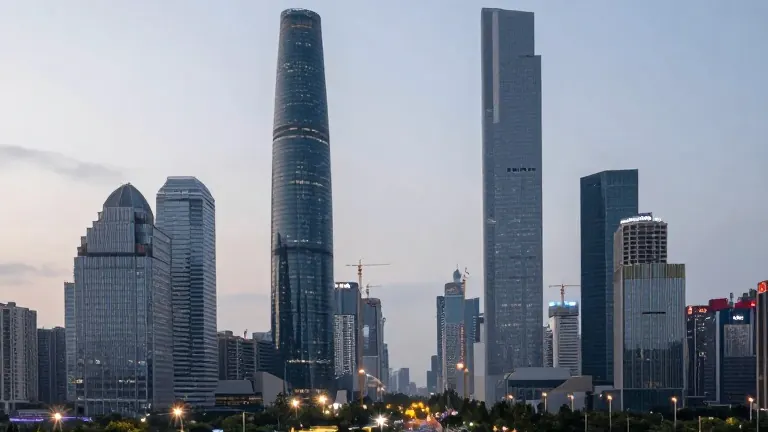
China's central government is facing a sudden drop in revenue from local authorities. This shift is forcing a rethink of how the country funds its infrastructure and public projects. The primary driver is the collapse in land sales, which has stripped cities of their main funding source.
The International Monetary Fund reports that general government debt stands at roughly 68.4% of GDP. However, when including off-balance sheet borrowing and local government financing vehicles, the total climbs to about 126.6% of GDP. This figure places China's debt levels on par with developed markets like the United States and Europe.
Ting Lu, chief China economist at Nomura, described the current situation as a true fiscal cliff. He noted that combined fiscal spending declined by 3.5% during the first eight months of the year. This contrasts with the 3.6% growth recorded over the same period last year. Lu stated that this drop is now a real drag on the wider economy.
The revenue shortfall traces back to the property slump that began in 2021. The Beijing think tank CF40 estimates that land-sale income has more than halved since that year. Revenue fell from 8.7 trillion yuan to 4.2 trillion yuan, equivalent to about $590 billion. Local governments relied on these sales for decades to build roads, rail lines, and industrial parks.
Urban fixed-asset investment has followed the same downward trend. It fell 3.8% last year, marking the first decline in decades. The drop steepened in the current year, with investment falling 7.2% in the first three quarters. Beijing maintained its official deficit target near 4% of GDP, but the Institute of International Finance estimates the actual deficit may reach 9%.
Beijing has ordered state-backed borrowers to clear hidden debt by mid-2027. These entities must transition into market-oriented commercial state-owned enterprises. S&P Global Ratings reported that hidden debt in these vehicles shrank to 6.5 trillion yuan last year, down from 14.3 trillion yuan in 2023. Many of these entities still lack the cash flow to cover interest payments.
Kristalina Georgieva, Managing Director of the IMF, urged Beijing to expand fiscal spending in the near term. She argued that this support should be clawed back over the medium term to ensure debt sustainability. Krishna Srinivasan, director of the IMF's Asia and Pacific department, added that China should move away from point growth targets to prevent resource misallocation.
Logan Wright, a partner at Rhodium Group, noted that no local official wants to be the first to default. However, he observed that if Beijing bails out one city, others may expect similar treatment. This dynamic can lead local officials to prioritize actions that conflict with central government goals.
Source: CNBC
More Business · Consumer Alerts · Report a business · Got a Story?