Oxford Street becomes car-free zone
London's main shopping artery closed to private vehicles on Monday, marking the first phase of a major regeneration plan.
By Sofia Wisniewski ·
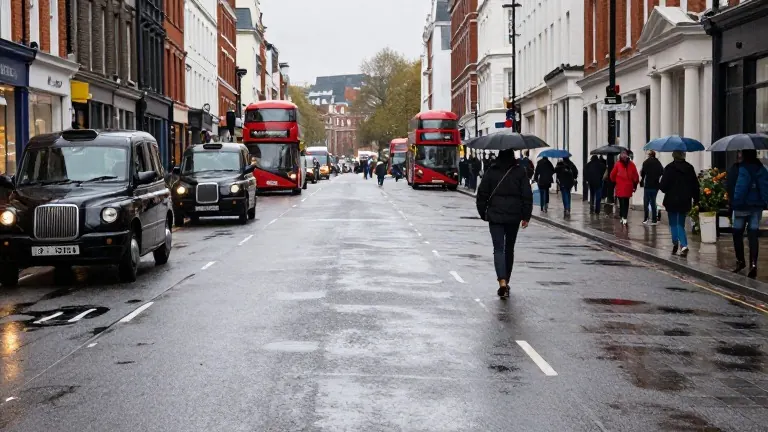
A one-kilometer stretch of Oxford Street in London has closed to vehicles, creating a pedestrian-only area that runs from Great Portland Street to Orchard Street. The change took effect on Monday, ending decades of shared traffic flow on the city's primary shopping route.
The economic stakes for this specific corridor are high. Approximately 1 percent of the United Kingdom's annual gross domestic product is generated along this 0.6-mile section. However, the area has faced declining consumer spending and falling rents in recent years. New West End Company data indicates that current foot traffic stands at just 57 percent of the levels recorded in 2006.
City Hall views this pedestrianization as a potential economic boost. Analysis by the Greater London Authority projects the change could generate over $109 million annually and support 700 new jobs. Following a trial weekend in October 2025, two-thirds of local businesses reported sales that were either higher or unchanged. This initial phase is part of a larger plan that will add two public squares, 50 trees, and hundreds of seats.
Early reactions from the public were mixed but generally positive among those who walked into the street. Muneera Alfadhel, a biology teacher, described the experience as magical. Mark Arbouine, a forensic scientist, noted the lack of traffic and praised the environmental benefits. Barbara Stoll, a campaigner for walkable cities, said the air felt cleaner and the noise levels were considerably lower. She observed that commuters emerging from the subway appeared excited by the open space.
Critics, however, raised concerns about accessibility and local disruption. Tim Barnes, deputy leader of the City of Westminster council, stated that communication with residents had been insufficient. He argued that the economic benefits were overstated and that the impact of rerouting buses to smaller streets had been overlooked. Resident Nerma Cridge warned that the West End could become too crowded and noisy at night. A French tourist said he would avoid the area entirely if buses and taxis could no longer pass through.
The project has a contested history. Mayor Sadiq Khan first proposed the closure in 2017, but the effort stalled in 2018 when Westminster Council withdrew support. Khan subsequently established the Oxford Street Development Corporation to transfer responsibility from local officials to the Greater London Authority and Transport for London.
The development corporation will review results in the coming months and examine findings early next year. Plans to convert the rest of Oxford Street into a permanent traffic-free space are expected to proceed by the end of next year. With mayoral elections scheduled for 2028, this initiative may stand as a defining part of Khan's final major projects.
Source: Al Jazeera