European Youth Protests See Lower Violence in France, But Germany Faces New Unrest
Arrests in Paris dropped sharply compared to previous weekends, while German cities saw looting and police clashes despite large peaceful marches.
By Stefan Kim ·
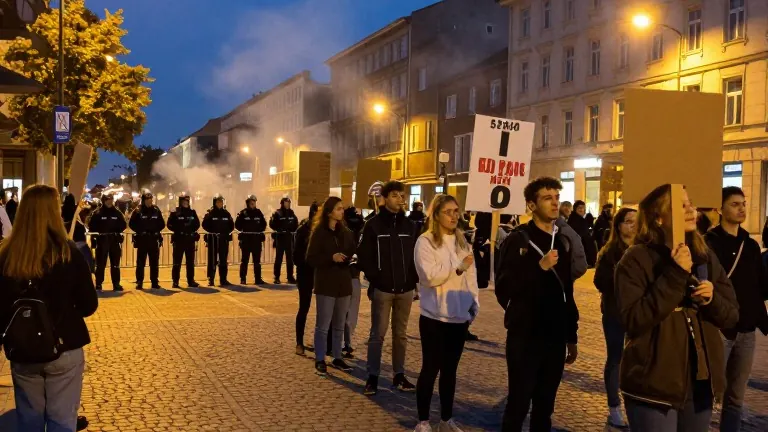
French authorities reported a sharp decrease in protest violence on Sunday, marking a calmer weekend than the previous two months of demonstrations. Police in Paris arrested 779 individuals as of Saturday night, a substantial drop from the 2,628 arrests recorded on Oct. 17 and the 1,314 arrests on Oct. 24. This reduction in numbers came after rioters targeted officers with Molotov cocktails at the end of a march on the eastern edge of Paris, injuring three police officers and setting a car on fire.
Violence in Paris remained contained compared to earlier weeks. Masked groups hurled fireworks at officers near the Eiffel Tower, prompting repeated police charges that caused tourists to flee the area. However, police in Paris and Marseille stated that only a handful of shops were targeted, with no major damage reported. A national police official told The Associated Press that authorities deployed approximately 70,000 police officers across the country to manage the event. The official, who spoke on condition of anonymity per police policy, noted that preparations anticipated a large turnout from both peaceful marchers and potential troublemakers.
Tensions are expected to rise again as high schools reopen on Monday. Student groups and labor unions have called for new nationwide protests on Tuesday and Thursday. The current movement centers on rising living costs, a theme that has driven demonstrations across the continent for several weeks. French officials expressed relief over the weekend's lower casualty counts but remain focused on the upcoming school term.
Germany experienced its own wave of unrest on Saturday, with more than 100,000 mostly young people protesting nationwide. Participants demanded increased government investment in education, housing, and climate protection, as well as measures to make daily life more affordable. While many marches were peaceful, the atmosphere turned volatile in several cities during the evening hours. In Frankfurt, rioters attacked police in the downtown area and looted stores. Several protesters and officers were injured, and 30 people were detained. Police cordoned off the central area, and the situation stabilized by early Sunday morning.
Boris Rhein, the governor of Hesse, reacted strongly to the events in Frankfurt. He described the violent excesses as shocking and stated that those who behaved like the attackers were placing themselves outside society. He emphasized that the incidents would not go unpunished. Similar violence occurred in Cologne, where police used water cannons to disperse crowds. In Berlin, protesters threw bottles and pyrotechnics at police lines.
The youth initiative Gen Z regelt, which organized the German protests, issued a statement on Instagram to distance the group from the unrest. The organization rejected any form of violence, including violent acts committed by other groups or individuals who were not part of the official demonstrations. German Interior Minister Alexander Dobrindt attributed the chaos to specific factions. He accused violent left-wing groups and troublemakers from the immigrant community of hijacking the peaceful demonstrations. Dobrindt told the daily paper Bild on Sunday that the rioters and looters would be identified and held accountable.
In Portugal, housing costs remained the central issue for demonstrators. Thousands marched through Lisbon during the day, inspired by similar movements in Spain. At the conclusion of the march, several hundred protesters camped out in Rossio, an iconic square in downtown Lisbon. Overnight, riot police intervened to clear the square. Officers removed tents and pushed protesters away, detaining a few individuals in the process. The forced removal marked the end of a weekend of activity that had seen large, largely peaceful crowds demanding more affordable housing.
The protests in France, Germany, and Portugal illustrate a coordinated wave of youth-led activism across Europe. While the scale of participation varied, the core demands regarding affordability and public investment remained consistent. Authorities in all three countries moved quickly to restore order, using a combination of large police deployments and targeted interventions to manage the crowds.
The next few days will be critical for French organizers. With schools reopening on Monday, the student population that has been central to the movement will return to campus. Union leaders and student groups will attempt to translate the momentum from the weekend's marches into sustained action on Tuesday and Thursday. Police in France and Germany are monitoring social media channels to gauge the scale of future gatherings.
Source: KSAT-TV