Oleshky evacuation begins under fragile four-day pause
A joint mission delivered supplies and moved residents from the besieged southern city, while drone strikes continued across the front line.
By Arjun Shah ·
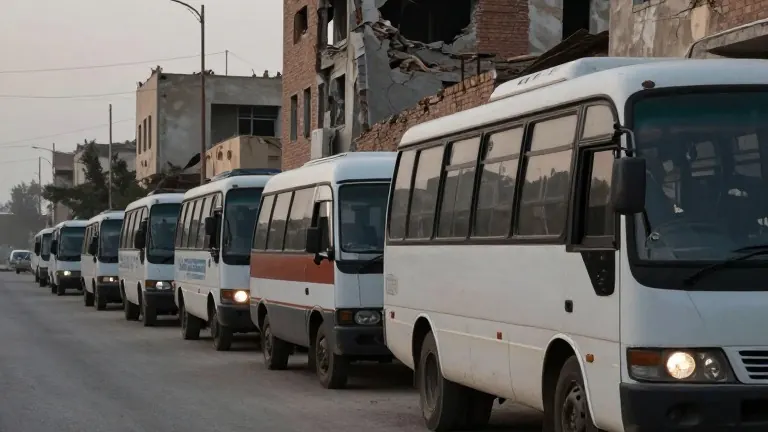
A convoy of 25 buses and ambulances entered the damaged city of Oleshky on Friday.
The movement marked the first major humanitarian access to the Russian occupied zone during the 4.5 year conflict.
Three key elements defined the operation: the scale of the logistics, the diplomatic coordination, and the continued violence outside the immediate perimeter.
The convoy, which originated in Armyansk, carried food and medicine for the approximately 2,000 people still living in the city.
Officials stated that demining teams cleared the designated routes late Thursday, a process that resulted in two deaths.
Ukraine’s ombudsman, Dmytro Lubinets, set the evacuation deadline for 2 p.m. local time.
Aid distribution was scheduled to begin 30 minutes after the evacuation concluded, though the specific time zone used remained unclear.
The United States played a central role in brokering the mission.
The White House attributed the arrangement to First Lady Melania Trump, while Pope Leo XIV also urged the leaders to support the relief effort.
Russia and Ukraine issued identical statements confirming that residents could leave safely or stay with guaranteed support.
Ksenia Arkhipova, a volunteer in Oleshky, told The Associated Press that roughly 1,000 residents wanted to depart.
She noted that the presence of a Ukrainian delegation was essential to assuage fears that Russian authorities might interrogate or detain those who left the city with Ukrainian papers or identification, though the text specifies fear of Russian interrogation or detention generally for those present or leaving under the mission's terms. Actually, the source says residents fear Russian authorities would interrogate or detain them. The Ukrainian delegation presence is cited as important by Arkhipova. The source does not specify why the Ukrainian delegation presence helps with Russian detention fears, only that it is important. I will stick to the source: she said it was important that the Ukrainian delegation was present. The fear is that Russian authorities would interrogate or detain them. The source does not explicitly link the two in a causal way beyond her statement. I will report her statement directly. She said the Ukrainian delegation's presence was important because many residents fear Russian authorities would interrogate or detain them. (Wait, the source says: "She said it was important that the Ukrainian delegation was present in Oleshky because many residents fear Russian authorities would interrogate or detain them." This implies the presence mitigates the fear. I will phrase it as: Arkhipova said the presence of the Ukrainian delegation was important because many residents feared Russian authorities would interrogate or detain them.) "The localized ceasefire in the Kherson region held for four days before the mission and is set to continue through Sunday evening." "Outside the immediate area, the fighting did not stop." "Russia’s Defense Ministry reported that air defenses downed more than 1,000 Ukrainian drones overnight." "Ukraine’s air force stated that Russia launched ballistic missiles and scores of drones." "Ukrainian territory sits just a couple of kilometers across the River Dnipro from Oleshky, but the specific route for evacuees crossing that distance was not made public." "A small number of Russian, Ukrainian, and U.S. media organizations were invited to cover the operation in the city."
Source: KSAT-TV